Some rivalries define a whole category. Ferrari versus Lamborghini. Mustang versus Camaro. And for an entire generation of enthusiasts raised on rally stages, video games, and turbocharged all-wheel-drive sedans: Subaru WRX STI versus Mitsubishi Lancer Evolution. Two Japanese companies built nearly the same idea — a compact four-door, turbocharged, all-wheel-drive rally weapon for the road — and spent two decades trying to beat each other on gravel and tarmac alike. Picking a side became a personality trait. Here’s the story of the rivalry, how the two cars actually differ, and which one to import.
 ## Born on the rally stage
Both cars exist because of the World Rally Championship. In the early 1990s, Subaru and Mitsubishi needed a competitive WRC car, and rally homologation rules required them to sell road-going versions of what they raced. So the road cars were, quite literally, rally cars you could buy.
Subaru’s Impreza WRX arrived in Japan in 1992, with the Subaru Tecnica International (STI) version following in 1993 — the same year both marques’ new weapons hit the WRC. Mitsubishi’s Lancer Evolution (“Evo”) launched in 1992 as well, built on the same homologation logic. For the next two decades the two traded blows: on the world rally stages through the 1990s and 2000s, and in showrooms, magazines, and video games everywhere else.
The WRC battles were genuinely close — both brands won championships and produced legendary drivers’ cars, and fans still argue over the exact tally. Mitsubishi was especially dominant in the Group N production-car class, taking seven consecutive titles from 1995 to 2001. Subaru’s works effort ran until it exited the WRC in 2008. The point was never really the precise scoreline — it was that these two, more than anyone, defined what a turbo-AWD rally car for the road could be.
How they actually differ
For two cars built on the same concept, the STI and Evo have distinct characters — and the differences are what fans argue about:
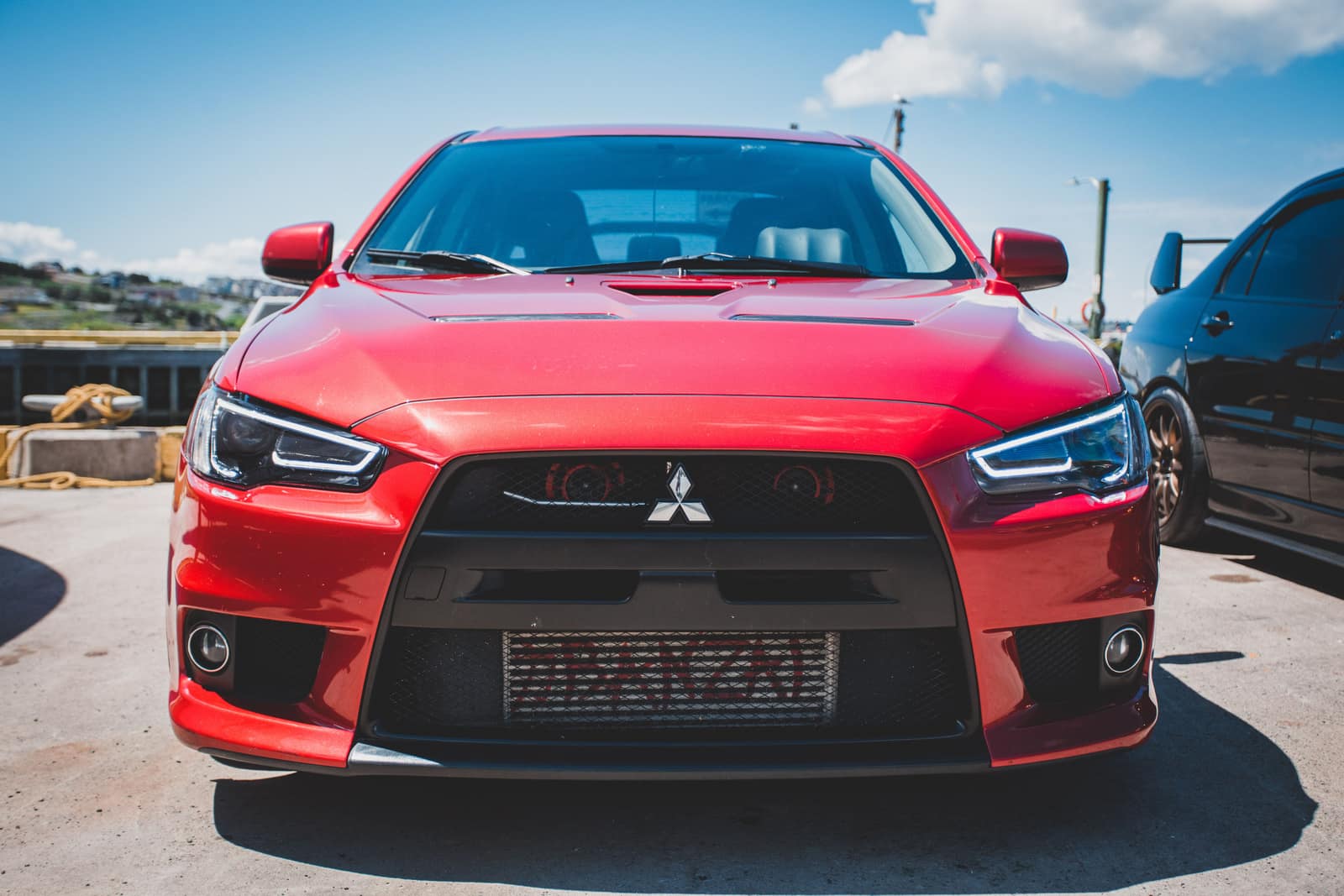
| Subaru WRX STI | Mitsubishi Lancer Evo | |
|---|---|---|
| Engine | Turbo boxer (flat-four) — low CoG, distinctive burble | Turbo inline-four — Japan-built Evos run the legendary 4G63 |
| Drivetrain | All-wheel drive | All-wheel drive |
| Body | Sedan (and later hatch) | Sedan |
| Rally programme | WRC works team through 2008 | 7 consecutive Group N titles (1995–2001) |
| On-road character | Fluid, polished, all-weather companion | Sharp, pointy, immediate — more hardcore |
| Production end | Continued after the Evo; eventually retired | Final Evo X — 2015 |
| Icon chassis | GC8 (incl. 22B STI) · GDB "Bugeye" | Evo I–IX (4G63-powered Japan-built generations) |
Broadly, enthusiasts characterize the STI as the more fluid, polished, all-weather companion — engaging and confidence-inspiring across any surface — and the Evo as the sharper, more hardcore, more immediate weapon, especially in its rawest forms. Neither is “better”; they’re different flavors of the same brilliant idea, which is exactly why the rivalry never resolved.
The icons of the rivalry
A few specific cars stand out for collectors and importers:
- Subaru GC8-generation Impreza (1992–2000), especially the limited 22B STI — the most coveted Subaru of all, a wide-body two-door homage to WRC success that was never sold new in the US and now commands enormous prices. The “Bugeye” GDB STI that followed (2000s) is also a hot import.
- Mitsubishi Lancer Evolution I–IX — the Japan-built generations (especially the Evo with the legendary 4G63 engine) are the enthusiast favorites. Earlier Evos were Japan-only, which is exactly why they’re sought-after imports as they cross the 25-year line.
Which should you import?
There’s no wrong answer — it comes down to character and what’s eligible:
- Eligibility is the first filter. Earlier 1990s STIs and Evos are crossing or past the 25-year line; later cars become eligible by build month. The earliest GC8 Imprezas and early Evos are the ones reaching importable age now. (See the 25-year rule explained and the 2026 JDM legends list.)
- Pick by character: want all-weather fluidity, the boxer burble, and Subaru’s rally identity? STI. Want the sharpest, most hardcore turn-in and the 4G63’s tuning legend? Evo.
- Both reward originality. These cars were built to be thrashed and modified — clean, original, unabused examples are increasingly rare and increasingly valuable. Read the auction sheet for hard use and accident history.
- Both are 25-year classics at 2.5% duty, exempt from the 2025 modern-vehicle tariff. (See the tariff guide.)
- Run the landed cost for the specific car before bidding. Use the Landed Cost Calculator.
Frequently asked questions
What’s the difference between the STI and the Evo?
The biggest difference is the engine: Subaru’s STI uses a turbocharged horizontally-opposed “boxer” four (low center of gravity, distinctive burble), while the Mitsubishi Evo uses a turbocharged inline-four (sharper, more nose-heavy turn-in). Both are all-wheel-drive, rally-bred performance sedans; the STI is often called more fluid and all-weather, the Evo sharper and more hardcore.
Which is better, STI or Evo?
Neither is objectively better — that’s why the rivalry endures. The STI is praised for fluid, confidence-inspiring all-surface pace; the Evo for razor-sharp, immediate handling. It comes down to driving character and which generation/condition you can find.
Are the STI and Evo legal to import?
Earlier 1990s STIs and Evos are crossing or past the 25-year line; later cars become eligible by month of manufacture. The earliest GC8 Imprezas and early Evos are reaching importable age now. Confirm the exact build month before buying.
Why are early STIs and Evos so valuable now?
Many of the best versions — like the Subaru 22B STI and early Japan-only Evos — were never sold new in markets like the US, so importing is the only way to get one. Combined with rally heritage and video-game fame, clean original examples command strong and rising prices.
What engine does each use?
The STI uses Subaru’s turbocharged boxer (horizontally-opposed) four-cylinder; the Evo uses a turbocharged inline-four — the Japan-built Evos famously running the tunable 4G63.
A rivalry that defined a category
The STI and Evo are proof that the best rivalries make both sides better. Two takes on one brilliant idea, fought out over two decades, leaving behind some of the most beloved performance cars ever built — and a debate that’ll never end. Whichever side you’re on, confirm eligibility in the 25-year rule guide, see the 2026 JDM legends, and price your pick in the Landed Cost Calculator.
Sources
- TopSpeed — Subaru/Mitsubishi: a legendary rally rivalry (WRX/STI/Evo history, power, gentleman’s agreement)
- HotCars — WRX STI vs Evo; Off-Road Legends rivalry (Group N titles, GC8 22B, WRC exit, Evo end 2015)
- ForceGT / Motor1 — STI vs Evo character comparisons
- Public WRC and Group N competition record
WATTSHIP intelligence is for reference and estimation. Eligibility is by month of manufacture and must be verified per vehicle; this is not legal advice. See our Disclaimer.